You can’t prove shilajit is real with a kitchen test; the only reliable proof is a recent lab report from an accredited laboratory for the batch you’re buying. At home, the most useful check is simple: good resin is glossy and dark, smells earthy, and dissolves almost completely in a warm drink.
The internet is full of other tricks, from setting resin alight to stretching it like toffee. Some tell you a little; most are myths. Here’s which is which, what a proper lab test shows, the red flags to watch for in a seller, and what good resin should look, smell and taste like.
Can shilajit be fake?
“Fake” can mean a few different things. It might be a product with little or no shilajit in it, resin bulked out with something cheaper, or genuine shilajit that was never cleaned or tested. We couldn’t find a published study that measures how much counterfeit shilajit is on sale. What research does show clearly is how much quality varies.
In a 2008 study, researchers bought 193 Ayurvedic products online and tested them for toxic metals. About one in five contained detectable lead, mercury or arsenic 1. One of them was a shilajit product, with 10.5 µg of lead per gram 1. Three-quarters of the products with metals claimed good manufacturing practice 1, so a reassuring label isn’t the same as a test result.
Later work points the same way. A 2022 analysis of shilajit produced in India and Pakistan found several toxic elements, including lead, arsenic and mercury, above standard limits 2. A 2025 study measured thallium in 13 raw shilajit samples and 6 commercial supplements, and some supplements contained more than the crude resin 3.
So the real question is less “is it shilajit?” and more “is it clean, and can the seller prove it?”
Do home tests for real shilajit work?
Mostly not. Real resin is a natural material that changes with temperature, moisture and origin, and many fakes can be made to pass the same tests. Here’s how the popular ones hold up.
| Home test | What people claim | What it really tells you | Verdict |
|---|---|---|---|
| Water dissolve | Real resin dissolves fully in warm water | Good resin melts into an even amber-brown drink; heavy grit suggests poor cleaning | Useful, but not proof |
| Flame or burn | Real shilajit won’t burn, it only bubbles | Shilajit is mostly organic matter, so it can char and smoke | Myth |
| Stretch or pull | Real resin stretches into strands when warm | Depends on room temperature and moisture; sticky syrups and tars stretch too | Myth |
| Temperature softening | Hard in the cold, soft in the hand | True of real resin, but also of many other sticky substances | Tells you little |
| Alcohol | Real shilajit won’t dissolve in alcohol | Part of its humic matter can dissolve in ethanol; results depend on the drink’s strength | Myth |
| Smell and taste | Real resin is bitter and earthy, never sweet | A sweet or perfumed smell is worth questioning; bitterness alone proves nothing | Useful warning sign |
The water test
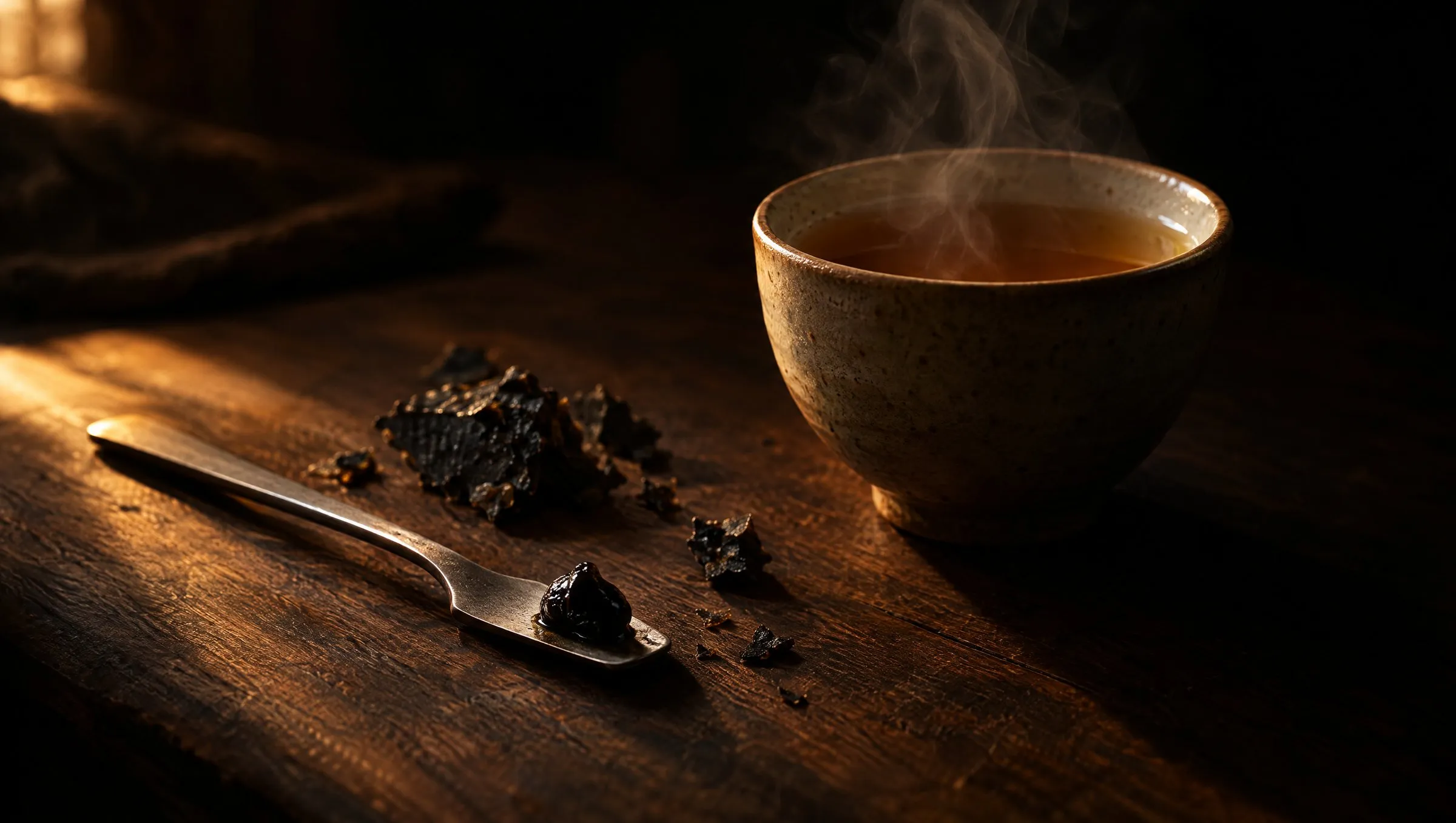
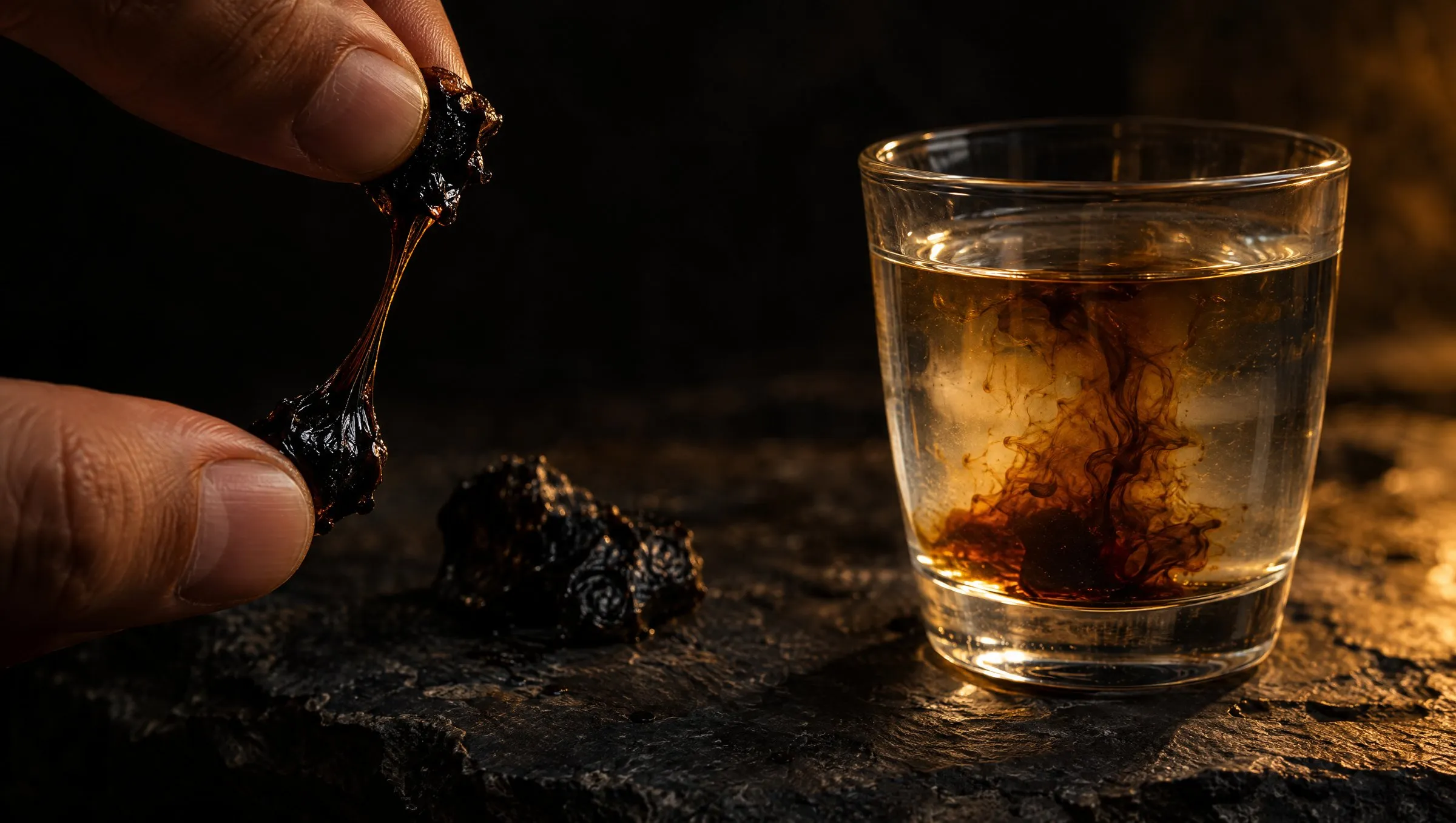
This is the one worth doing, because it’s also how you’ll take your resin. Shilajit’s main component, fulvic acid, stays dissolved in water at any acidity 4. Stir a pea-sized piece into a warm drink and good resin melts within a minute or two, turning the cup an even deep amber-brown. A fine trace of sediment is normal. Sand, grit or lumps that never soften suggest the resin wasn’t cleaned well. The catch is that plenty of other substances dissolve in water too, so a clean cup is a good sign, not a guarantee.
The flame test
This one is a myth. More than 80% of shilajit’s weight is humic substances, the organic matter left by plants broken down over a very long time 5. Organic matter heated in a flame bubbles, chars and smokes. Whether a lump “burns” depends mostly on how much water it holds and how long you heat it. It’s also an easy way to burn your fingers.
The stretch and softening tests
Shilajit has been described as an exudation “of variable consistency” 6. That fits what anyone with a jar knows: it goes glassy in a cold kitchen and soft on a warm day. So how far a piece stretches mostly tells you the temperature of the room. Sugar syrups, tars and gums stretch nicely too.
The alcohol test
The claim is that real shilajit won’t dissolve in alcohol. But humic matter isn’t one substance, and one fraction of it, called hymatomelanic acids, is soluble in ethanol 4. The result depends on the alcohol’s strength, the water in the resin and how long you wait. A cloudy, half-dissolved glass doesn’t settle anything.
What does real shilajit look, smell and taste like?
Your senses won’t prove authenticity, but they’re a good first filter. Shilajit is described in the research as pale-brown to blackish-brown 6. Good raw resin is usually very dark, close to black, with a glossy, tar-like surface.
The taste is bitter 7. The smell is strong and earthy, with smoky and slightly sour notes. One review compared it, rather unkindly, to cow’s urine 7. Either way, it never smells like sweets, perfume or chemicals.
| Sign | Good resin | Worth questioning |
|---|---|---|
| Colour | Very dark brown to black, glossy | Grey, dull, or noticeably light and uniform |
| Texture | Firm when cold, soft and sticky when warm | Powdery, crumbly or gritty at any temperature |
| Smell | Earthy, smoky, slightly sour | Sweet, perfumed or like solvent |
| Taste | Bitter, smoky, mineral | Sugary or bland |
| In a warm drink | Melts into even amber-brown | Leaves sand, grit or lumps |
If the taste surprises you at first, that’s normal. Most people find it softens nicely in warm tea or milk, and our guide on how to take shilajit has easy ways to enjoy it.
What does a lab test for shilajit actually show?
A lab can see what no kitchen test can. These are the three areas that matter most.
Heavy metals. Shilajit forms in rock, so it carries metals from the rock. A 2024 review counted around 65 metals reported in shilajit, including lead, arsenic, cadmium and mercury 8. Most published samples were within international limits for herbal products, but a few studies found levels above them 8. That’s why a test of the specific batch matters more than any general promise.
Fulvic acid and markers. Labs can measure total fulvic acid by weight and use chromatography to look for characteristic compounds. A 2026 study developed methods to measure fulvic acid, hippuric acid and urolithin A in shilajit, and quantified 14 elements, for routine quality control 9. A fulvic acid figure is only as good as the method behind it, so look for the method named on the report.
Microbes. Resin straight from the mountain carries soil and plant debris. A 2010 review noted that unprocessed shilajit has been found contaminated with moulds such as Aspergillus niger 7. That’s why careful producers clean their resin, and why a fuller lab panel can include yeast, mould and bacteria counts.
A serious seller can arrange all of these. What matters is that they publish the results.
How do you read a shilajit lab report?
A good report is a plain document, and you don’t need a science degree to check it. Look for these things:
- The laboratory’s name and accreditation. An accreditation number means the lab’s methods are independently audited.
- A report number and date. You should be able to tell when the test was done.
- A batch number. Natural resin varies, so a result applies to the batch tested.
- Lead, arsenic, cadmium and mercury. These four are the heavy metals that matter most for shilajit.
- Units and limits. Results are usually in mg/kg. Compare them with the EU maximum levels for food supplements.
- The full PDF. A screenshot of a table, or the word “tested” on a label, isn’t the same thing.
Remember the scale, too. A typical serving is about 100 mg, which is one ten-thousandth of a kilogram.
This is exactly how we publish ours. Hilasti’s resin was tested for lead, arsenic, cadmium and mercury by an accredited EU laboratory, and the report number, date, batch and every figure are on our lab results page, with the full PDF to download. If you’d like the report for your own batch, just ask. For a deeper walk-through, shilajit.uk has a guide to spotting fake shilajit.
What are the red flags when buying shilajit?
Most poor products give themselves away before you open the jar. Here are the signs to watch for.
| Red flag | Why it matters |
|---|---|
| No lab report, or “available on request” that never arrives | Without a test, there’s no evidence the batch is clean |
| No batch number on the jar or the report | You can’t link a test result to what you’re holding |
| Unclear origin, such as “Himalayan” with no country or region | A named source suggests the seller knows the supply chain |
| A price far below other tested brands | Harvesting at altitude, cleaning and testing all cost money |
| Long ingredient lists, sugar or flavourings in “pure resin” | Real resin needs nothing added |
| Headline numbers like “84 minerals” | No study backs that number; a lab report is more useful |
| Promises to cure or fix health problems | A food supplement isn’t a medicine, and honest sellers don’t talk as if it were |
| Sweet smell, powdery texture or grit in the cup | Not what good raw resin is like |
The “84 minerals” figure is everywhere, but we couldn’t trace it to any study. Our guide to fulvic acid and minerals in shilajit explains what’s really in the resin.
Why does origin matter?
Every shilajit carries the character of the mountain it came from: its rock, its altitude and the plants that once grew there. A seller who names the region, and ideally the altitude, is telling you they know where their resin begins.
Ours comes from the Nepalese Himalayas, harvested at around 4,800 metres, roughly the height of Mont Blanc’s summit. It’s sold raw, with no fillers, flavourings or additives, so the jar holds shilajit and nothing else. You can read more about where the resin forms and how it’s gathered in what is shilajit.
How do you check your own jar at home?
Put the tests above together and you have a sensible two-minute routine for any new jar.
- Read the paperwork first. Find the batch number on the jar and match it to a lab report from an accredited lab.
- Look. The resin should be dark and glossy. Firm or soft both are fine, depending on the room.
- Smell. Earthy and smoky is right. Sweet or perfumed isn’t.
- Dissolve a serving. Stir a pea-sized piece, about 100 mg, into a warm (not boiling) drink. It should melt into an even amber-brown cup with little or no grit.
- Taste. Expect bitter, smoky and mineral. A sugary taste is a warning sign.
Every Hilasti jar comes with a steel spatula, so your test serving is the same size as your everyday one. Keep the jar closed in a cool, dry place away from sunlight. If it turns hard in winter, hold it in your hand for a minute. Our FAQ covers more on storage and serving.
Taste the real thing
If you’d like to try resin you can check for yourself, our raw Himalayan shilajit resin is harvested in Nepal at around 4,800 m, with nothing added, and its heavy-metal results from an accredited EU lab are there for you to read. The steel spatula is in the box, so all that’s left is a warm cup and a quiet moment. Both jar sizes are in our shop.
This article is for information only and isn’t medical advice. Speak to your doctor or pharmacist before taking a supplement, especially if you’re pregnant, breastfeeding, take medication or have a health condition.