
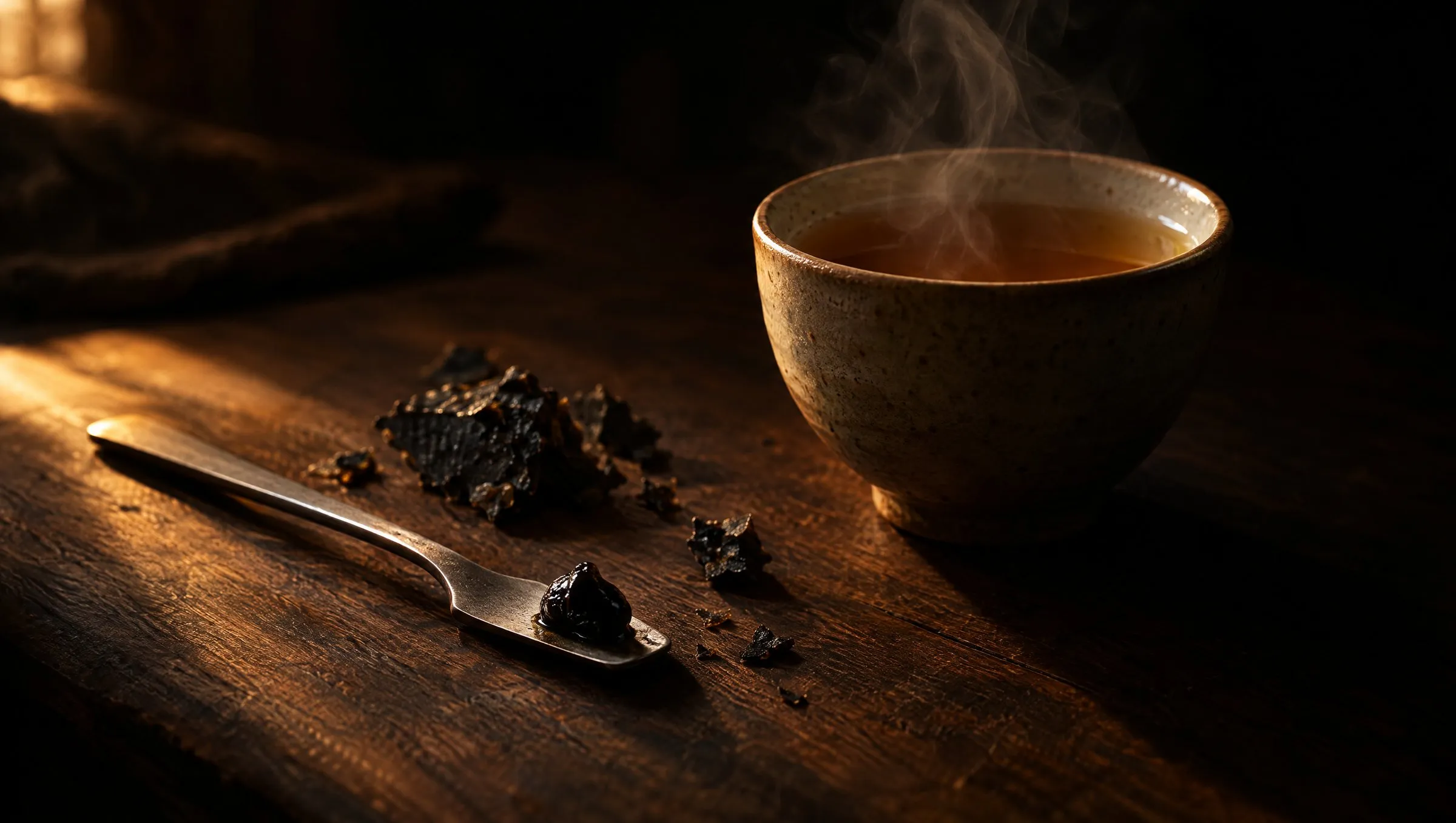
To take shilajit resin, scoop a pea-sized piece, about 100 mg, and stir it into a warm drink such as water, tea or milk until it melts. Most people have one serving in the morning, and you can go up to two or three a day if the label allows it.
That’s the short version. Below you’ll find exactly how much to scoop, what to mix it with, when to take it, how to make it a habit that sticks, and what to do when the resin is too hard, too soft or slow to dissolve.
How much shilajit should you take?
A suggested serving of raw resin is about 100 mg. That’s roughly the size of a pea, or a grain of rice for a first taste. It’s a smaller amount than most people expect, because the resin is dense and concentrated.
Measuring by eye is tricky, so every Hilasti jar comes with a steel measuring spatula. Scoop about half of the wide end and you have your serving. It’s the same amount every day, with no guesswork and no sticky fingers.
Hilasti’s label suggests up to two or three servings a day. Many people start with one in the morning and happily keep it there. Whatever brand you buy, follow its own label: EU law requires every food supplement to state the recommended daily portion and a warning not to exceed it 1. Servings vary between products, because a capsule of dried extract isn’t the same as a piece of raw resin.
How do you take shilajit resin, step by step?
It takes about two minutes, and it soon becomes second nature.
- Warm your drink. Heat water, tea or milk until it’s hot but not boiling, the temperature you’d happily sip. Very cold drinks melt resin slowly.
- Scoop. Take your serving with the spatula. If the resin is firm, press the edge of the spatula in and twist.
- Drop it in. Dip the spatula into the cup and let the resin slide off. A few seconds in the warm liquid loosens any that clings.
- Stir. Stir for a minute or so, until the drink turns an even, deep amber-brown and you can’t see any pieces.
- Sip. Drink it while it’s warm. Give it one more stir halfway if it has settled.
One tip matters more than most: don’t dissolve shilajit in tap water. Use filtered or bottled water instead. Hilasti’s label asks for this, and many people find it gives a cleaner, rounder taste without the flat, chlorine edge tap water can add.
What can you mix shilajit with?
Shilajit tastes earthy, smoky and a little bitter. Some people love it straight in warm water. Others prefer to pair it with something that rounds off the edges. Here are the drinks people come back to most.
| Drink | What it tastes like | Good for |
|---|---|---|
| Warm filtered water | Pure, earthy and mineral | Tasting the resin as it is |
| Black tea | Malty; the tea’s tannins blend in | A familiar morning cup |
| Green tea | Light and grassy, with a smoky finish | A gentler afternoon drink |
| Warm milk or oat milk | Creamy and mellow, almost like cocoa | First-timers and evenings |
| Ginger or mint tea | Bright and fresh, lifts the smoky notes | Anyone who finds it too earthy |
| Coffee | Bold; the bitterness hides the resin well | People who never skip coffee |
| Warm water with lemon and honey | Sweet, sharp and soothing | A softer, rounder flavour |
A few small extras work well too. A teaspoon of honey, a pinch of cinnamon or cardamom, or a splash of vanilla in warm milk all turn it into something closer to a treat. Stir the resin in first, then add your extras, so you can see it has fully melted.
Should you take shilajit in the morning or at night?
There’s no fixed best time. Most people take it in the morning, often as the first warm drink of the day, because it slots neatly into a routine that already exists.
Others prefer it in the afternoon, when the day slows down, or as a calm evening cup of warm milk. If you take two servings, a morning cup and an afternoon cup is a simple rhythm.
Empty stomach or with food is just as open. Plenty of people have it before breakfast, while those with a sensitive stomach often find it more comfortable with or after a meal. Pick the time you’ll actually stick to. Consistency matters more than the clock.
How do you make shilajit part of your day?
The people who enjoy shilajit most tend to treat it as a small ritual rather than a chore. A few habits help.
- Anchor it. Tie it to something you already do every day: boiling the kettle, your first coffee, or winding down after dinner.
- Keep the jar in sight. Next to the tea caddy or the kettle works better than a cupboard. Just keep it out of direct sunlight and out of reach of young children 1.
- Use the same cup. It sounds small, but a favourite mug makes the moment feel like yours.
- Take two minutes. Watch the resin soften and the colour spread. That quiet pause is part of why so many people keep the habit.
Travelling? The jar is small enough for a wash bag. Soft resin can count as a paste at airport security, so put it in your liquids bag or your checked luggage. Some people prepare a week of servings before a trip: roll pea-sized pieces between their fingertips and keep them in a small tin lined with baking paper so they don’t stick together. A flask of hot water in a hotel or office does the rest.
What if your resin is too hard, too soft or won’t dissolve?
Raw resin is a natural material, and it reacts to temperature like honey or dark chocolate. All of these are normal and easy to fix.
| What you notice | Why it happens | What to do |
|---|---|---|
| Too hard to scoop | It’s cold; resin turns firm, even glassy, in winter | Hold the closed jar in your hand for a minute, or near (not on) a warm radiator |
| Soft, sticky or runny | It’s warm; resin softens in summer heat | Put the jar somewhere cooler for an hour; it firms up again |
| Sticks to the spatula | Warm resin clings | Dip the spatula into your warm drink and stir with it |
| Slow to dissolve | Drink too cool, or a large piece | Use hotter (not boiling) water, break the piece smaller, and keep stirring |
| A little sediment at the bottom | Fine natural particles settle | Stir again before your last sip |
| Taste too strong | It’s a bold, earthy flavour | Use milk, tea or honey, or start with a smaller piece and build up |
Can you just chew it? Some people let a tiny piece melt in the mouth. It works, but the taste is intense and it sticks to your teeth. Most people find a warm drink far more pleasant, and it’s the way shilajit has traditionally been taken.
If the taste is the only thing holding you back, give it a week. Many people find the earthy, smoky flavour grows on them, the way black coffee or dark chocolate does. Our guide to what shilajit is describes how good resin looks, feels and tastes.
What doses have studies used?
Researchers have tested shilajit in a handful of small human trials, usually as a purified extract in capsules rather than raw resin. In a 90-day trial in men aged 45 to 55, volunteers took 250 mg twice a day 2. In a 48-week trial in 60 postmenopausal women, the groups took 250 mg or 500 mg a day 3. In an 8-week trial in 35 young men who trained regularly, the groups took 500 mg or 1,000 mg a day 4.
These were small studies of specific extracts, so their doses don’t translate directly to a piece of raw resin. They describe what was given and measured, not a promised result. You can read more about what each trial looked at in our overview of shilajit benefits and research, and in shilajit and the gym if you train.
How long does a jar last, and how do you store it?
At about 100 mg a serving, a little resin goes a long way.
| Hilasti jar | Servings | At one serving a day | Price |
|---|---|---|---|
| 30 g | About 300 | Around ten months | €34.99 |
| 15 g | About 150 | Around five months | €24.99 |
The 15 g jar is a good way to try the ritual. The 30 g jar is the better value once you know you enjoy it. Both are in our shop.
Store the jar with the lid closed in a cool, dry place, away from direct sunlight. It keeps for up to 2 years. It will firm up in a cold room and soften on a hot day, which is simply how raw resin behaves. If it’s hard to scoop, warm the jar in your hand for a minute. There’s more on serving and storage in our FAQ.
Who should not take shilajit?
Don’t take shilajit if you’re pregnant or breastfeeding, and don’t give it to children. If you take any medication, or have a health condition such as gout or a condition that affects iron levels, ask your doctor or pharmacist first.
Shilajit is a food supplement, not a medicine. It’s an addition to a varied, balanced diet, not a replacement for one. For the bigger picture on why people take it, read why take shilajit.
Start your own ritual
If you’d like to start your own morning ritual, our raw Himalayan shilajit resin is harvested in Nepal at around 4,800 m, with nothing added. Its heavy metals were tested by an accredited EU laboratory, and you can see every figure on our lab results page. The steel spatula in the box makes your pea-sized serving easy to scoop, so all that’s left is choosing your favourite warm drink.
This article is for information only and isn’t medical advice. Speak to your doctor or pharmacist before taking a supplement, especially if you’re pregnant, breastfeeding, take medication or have a health condition.