Most people who take shilajit notice nothing more than its strong, earthy taste, and the small human trials published so far recorded few side effects, all of them mild. The real risks lie elsewhere: in contaminated or uncleaned resin, and for a few groups of people who should skip it or check with a doctor first.
Below you’ll find what the trials actually recorded, the small things people notice and how to ease them, why contamination matters more than anything else, who should avoid shilajit, and what is known about daily and long-term use.
What are the side effects of shilajit?
Search for “shilajit side effects” and you’ll find long lists: headaches, dizziness, rashes, changes in blood pressure. Very few of those lists say where they come from. So we went back to the human trials and read what each one recorded.
The short answer is that the trials found little. A 2014 review of shilajit’s safety described it as well documented in animal and human studies, while also noting that relatively few well-controlled human trials have been done 1. The largest number of side effects we found in any trial came from a 2026 study of raw resin: seven of 25 men reported something mild, from acne to an upset stomach, and all of it cleared up by itself 2.
That’s useful background, but it isn’t a promise. These were small studies, mostly in healthy adults and often using a purified extract rather than raw resin, and none was large enough to pick up rare reactions.
What did the human trials record?
Here are the human trials we could open that reported on side effects or safety tests. Each one was designed to measure something else, such as strength or blood markers, and recorded side effects along the way.
| Trial | Who took part | Daily amount, length | Side effects recorded |
|---|---|---|---|
| 2026, raw resin 2 | 25 healthy men aged 21 to 55 | 500 mg, 28 days | 7 had mild events; none serious |
| 2020, momiai 3 | 160 adults after shinbone surgery | Two 500 mg capsules, 28 days | Same rate as placebo |
| 2019, extract 4 | 63 active young men | 250 or 500 mg, 8 weeks | None reported |
| 2010, extract 5 | 35 men with low sperm counts | 200 mg, 90 days | Liver and kidney tests unchanged |
| 2019, extract 6 | 45 healthy women aged 30 to 65 | 250 or 500 mg, 14 weeks | None linked to shilajit |
The 2026 study had no placebo group. Its mild events were acne in two men, and a rash, itching, stomach ache, indigestion, a cough and a fever in one each. All cleared up, nobody stopped taking part, and the researchers judged most of them unlikely to be related to the resin. Liver, kidney and blood-count tests stayed within normal limits 2. In the 2010 study, seven of the 35 men didn’t finish, and the summary doesn’t say why 5.
The limits are worth one honest sentence: all of these trials were small and short, and several were run with a single branded extract. They tell you what happened in those groups, not what will happen to you.
What mild things do people notice?
Away from the trials, the things people mention are mostly about the experience of taking it. None of them is dramatic, and each has a simple fix.
| What you notice | Likely cause | What to do |
|---|---|---|
| A strong, bitter, smoky taste | That’s simply how raw resin tastes | Stir it into tea, warm milk or coffee, or add a little honey |
| Mild queasiness or an unsettled stomach | A large piece, a very strong drink, or an empty stomach | Use a smaller piece, more liquid, and take it with or after food |
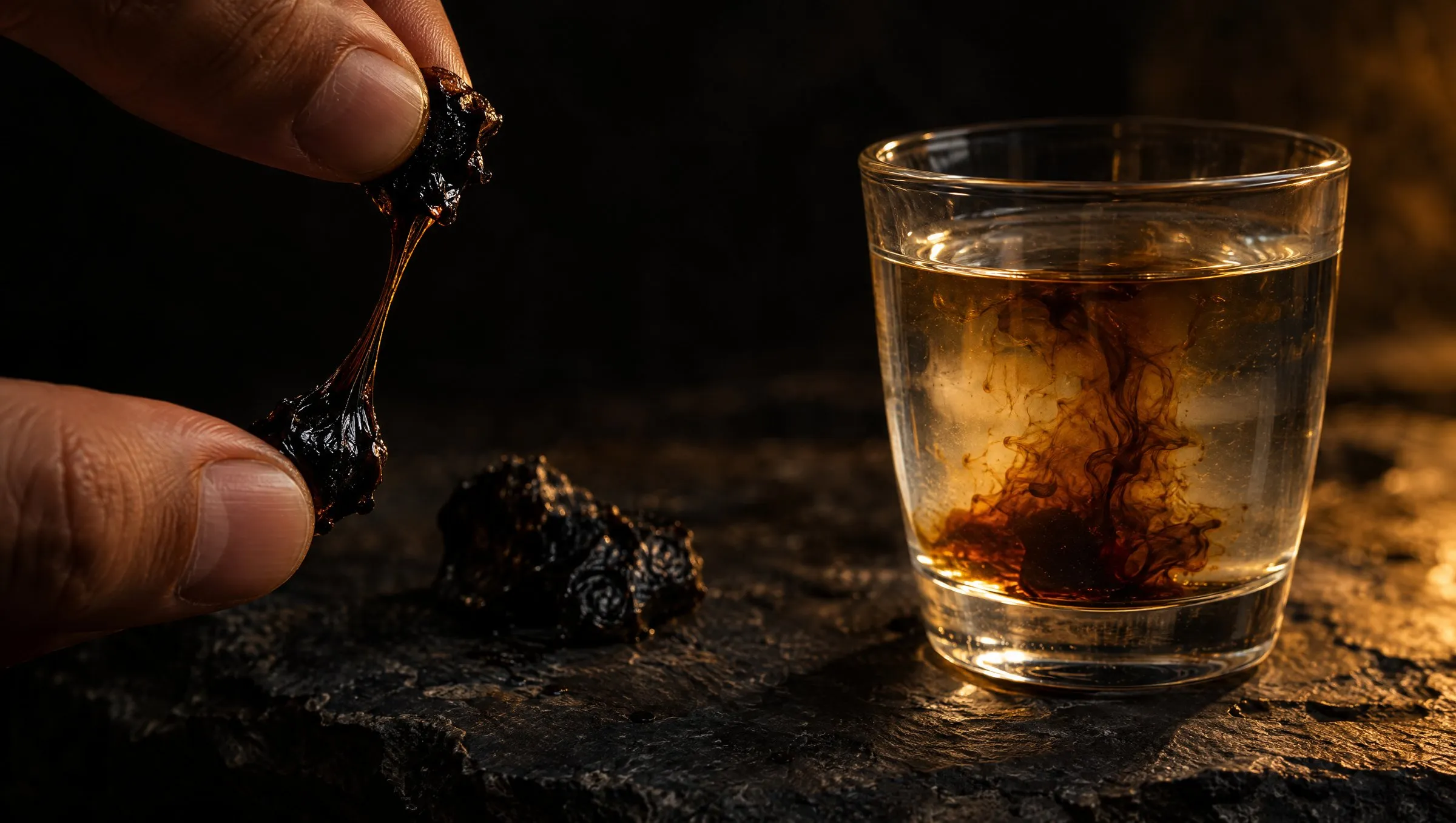
| A heavy, earthy aftertaste | Resin that hasn’t fully dissolved | Stir until the drink is an even amber-brown, and sip a glass of water after |
| Resin stuck to your teeth | Chewing it or letting it melt in your mouth | Dissolve it in a warm drink instead |
| Itching, a rash or swelling | Possible sensitivity, which is rare | Stop taking it and speak to a doctor or pharmacist |
Most of these come down to the same thing: too much, too strong, too fast. Shilajit is dense, and a serving is smaller than people expect.
How do you start gently?
If you’re new to shilajit, begin small. A piece the size of a grain of rice is plenty for the first few days. After that, move up to the usual pea-sized serving of about 100 mg.
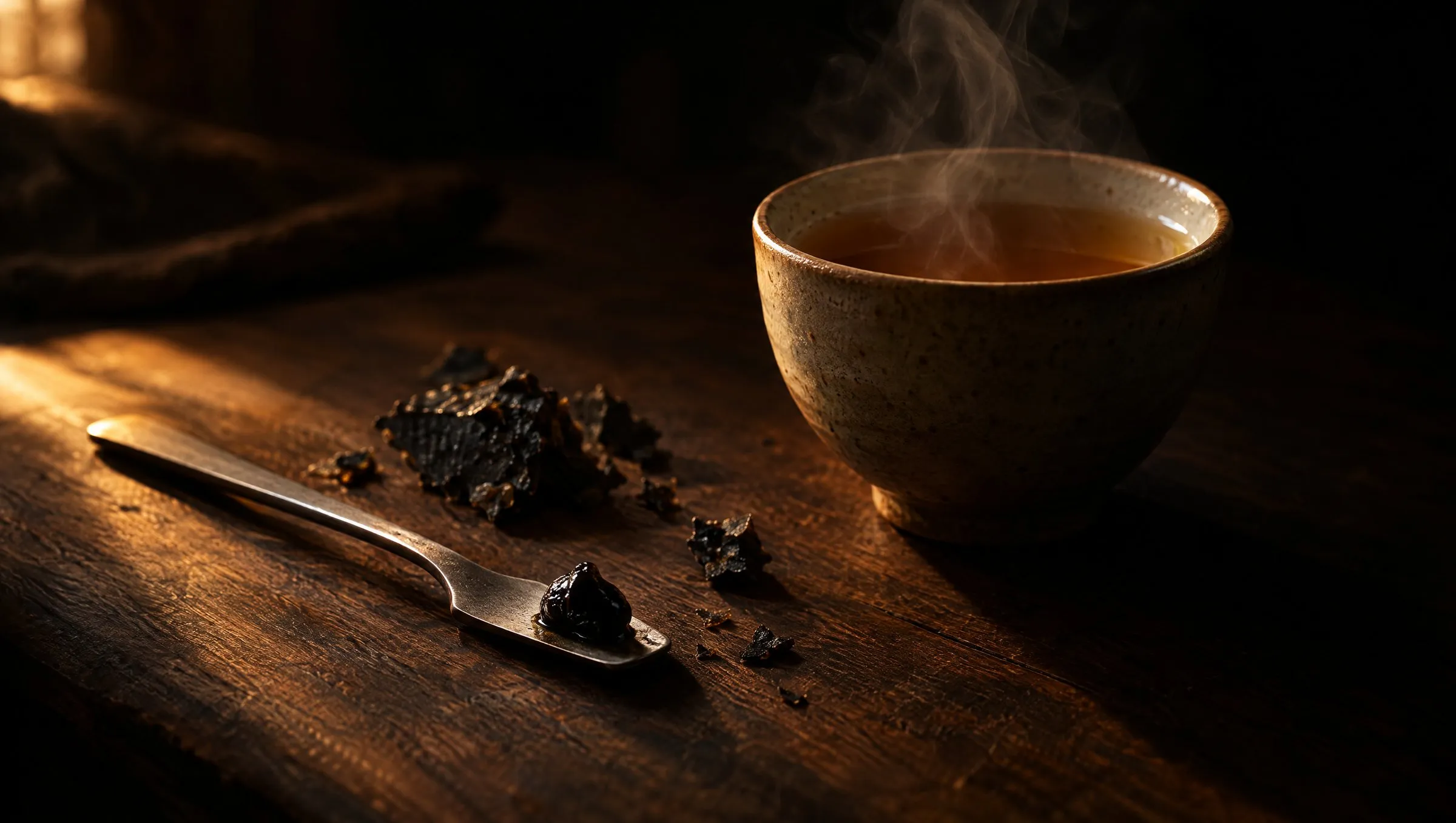
Every Hilasti jar comes with a steel measuring spatula, so you get the same serving every time. Half of the wide end is a full serving, and a light touch of the tip is a gentle first taste. No guessing, and no sticky fingers.
Then dissolve it properly. Stir it into a cup of warm water, tea or milk, hot but not boiling, until no pieces are left. A warm drink is the traditional way to take it, and it’s far kinder on the palate than a lump on the tongue. Having it with breakfast, rather than before, suits anyone with a sensitive stomach. Our guide on how to take shilajit has the full routine and the drinks people like best.
Whatever brand you buy, follow its label. EU law requires every food supplement to state the recommended daily portion and a warning not to exceed it 7.
Is contamination the real risk?
Yes. If anything about shilajit deserves your attention, it’s what else might be in the jar.
Shilajit forms in mountain rock, so it carries minerals from that rock. A 2024 review counted around 65 metals reported in shilajit, including lead, arsenic, cadmium and mercury 8. In most published samples the levels were below international limits for herbal products, but a few studies found them above 8. A 2026 analysis of 12 samples from different regions also found iron, zinc and manganese among the essential elements, with the toxic metals in those samples below toxicity thresholds 9.
Uncleaned resin straight from the rock is another matter. A 2010 review warned that unprocessed shilajit shouldn’t be used, because it has been found contaminated with moulds such as Aspergillus niger 10. That’s why careful producers clean their resin before selling it.
So the questions to ask a seller are simple: was this batch tested, by whom, and can I see the report? Our guide to real vs fake shilajit explains the home tests and the red flags, and you can see how a full heavy-metal report looks on our lab results page.
Who should avoid shilajit or ask a doctor first?
For most healthy adults, shilajit is simply a food supplement with a strong taste. A few groups should leave it out or check first.
| Who | Our advice | Why |
|---|---|---|
| Pregnant or breastfeeding | Don’t take it | No safety studies, and one published case of a problem in pregnancy |
| Children | Don’t give it | It hasn’t been studied in children |
| Taking any medication | Ask your doctor or pharmacist first | No interaction studies exist |
| Gout or high uric acid | Ask your doctor first | Not studied in people with these conditions |
| Haemochromatosis or other iron conditions | Ask your doctor first | Shilajit contains iron |
| High or low blood pressure, or on blood pressure medicine | Ask your doctor first | Not studied, and one case of raised blood pressure |
Pregnancy and breastfeeding. No trial has looked at shilajit in pregnancy or while breastfeeding. A 2018 case report described a 37-year-old pregnant woman with persistent high blood pressure and low potassium after six months of taking mumijo. Her doctors linked it to the mumijo, and it settled after she stopped 11. One case proves little on its own, but it’s a good reason to wait.
Iron-related conditions. Shilajit naturally contains iron 9. The NHS advises people with haemochromatosis to avoid iron supplements, because they may be harmful for people with high iron levels 12. If you have haemochromatosis or any condition affecting your iron levels, speak to your doctor before taking shilajit.
Gout, high uric acid and blood pressure. We couldn’t find good human research on shilajit in people with gout or high uric acid, or in people with low blood pressure. That absence is the point: nobody has checked. If any of these apply to you, or you take medicine for blood pressure, ask your doctor first.
Children. Shilajit hasn’t been studied in children, so keep the jar out of their reach, as every food supplement label asks 7.
Can shilajit interact with medication?
Nobody knows for certain, because the studies haven’t been done. The authors of a 2019 case report noted that no studies on how shilajit is absorbed and acts in the body were available 13. Without those, nobody can say with confidence which medicines it might affect.
That same report described a rare reaction. A 43-year-old woman taking a product containing shilajit developed hives and later a severe allergic reaction after exercise. Her doctors thought shilajit may have acted as one trigger alongside an underlying mast-cell condition 13. Reports like this are very rare, but they show why itching, swelling or a rash means stopping and seeing a doctor.
If you take any regular medicine, whatever it’s for, show the jar to your pharmacist before you start. It takes two minutes, and they can check it against everything else you take.
Is it safe to take shilajit every day?
Every trial above gave shilajit daily. The studies above lasted 28 days to 14 weeks 2 6. The longest human trial we found ran for 48 weeks, in 60 postmenopausal women taking 250 mg or 500 mg of extract a day 14.
In an animal study, rats were given shilajit for 91 days at doses far above anything a person would take. The researchers saw normal organ weights and only negligible changes in the liver and intestine at the very highest dose 15. Animal results don’t translate directly to people, but they add some background.
What doesn’t exist yet are long-term studies of people taking shilajit for many years. So the sensible approach is the ordinary one: stick to the serving on the label, choose a tested product, and check with your doctor if your health changes or you start a new medicine.
How do you choose a shilajit you can trust?
Since contamination is the main concern, the best thing you can do is buy resin with proof behind it. Look for a named origin, a batch number, and a lab report you can actually read.
Hilasti’s resin is harvested in Nepal at around 4,800 m and sold raw, with nothing added. Its heavy metals were tested by an accredited EU laboratory, and the report number, batch and every figure are on our lab results page. If you’d like the report for your own batch, just ask. There’s more on serving, storage and testing in our FAQ, and on where the resin comes from in what is shilajit.
Try it with confidence
If you’d like to start your own ritual, our raw Himalayan shilajit resin comes from a tested batch, with a steel spatula in the box so your first small taste and every serving after it is easy to measure. Stir it into a warm cup, take a quiet minute, and see how you like it. Both jar sizes are in our shop.
This article is for information only and isn’t medical advice. Speak to your doctor or pharmacist before taking a supplement, especially if you’re pregnant, breastfeeding, take medication or have a health condition.